
Congos of Villa Mella
A sacred communal world of music, movement, faith, mourning, and memory.
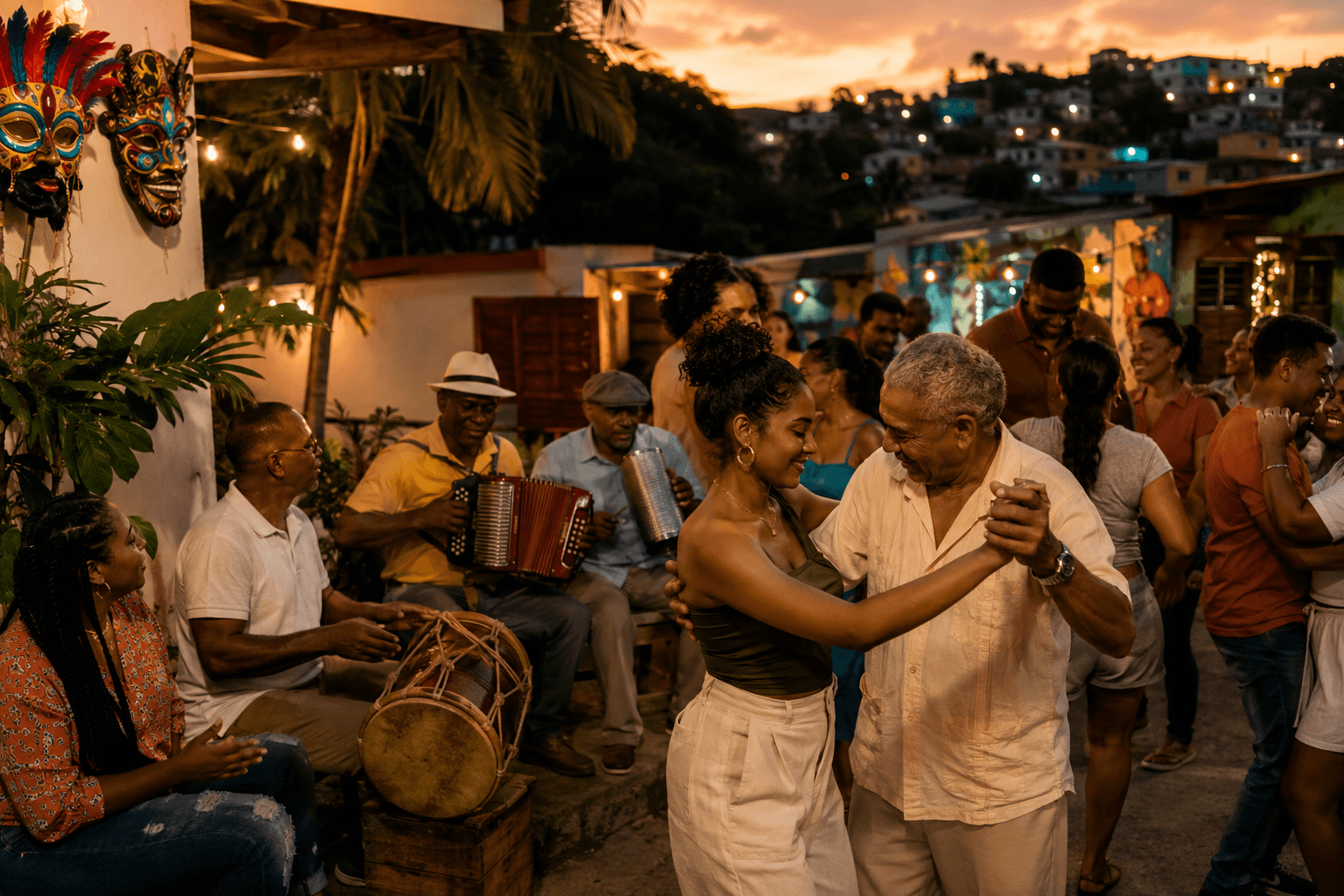
Follow Dominican culture through music, dance, carnival, memory, art, food, sport, faith, oral tradition, and the communities that keep each practice alive on the island and across the diaspora.
Start with a rhythm, a neighborhood, a family story, a stadium, a museum, or a mask workshop. They all open a different door into the Dominican Republic.
Dominican culture does not live in one city, one rhythm, or one version of the past. It changes as you move through the country.
In the Cibao, an accordion, güira, and tambora can pull a room toward merengue típico. In San Pedro de Macorís, Cocolo dance drama carries histories of migration, sugar communities, theater, and mutual aid. In Villa Mella, drums, movement, faith, mourning, and memory belong to one sacred communal world.
This hub does not flatten those differences. It gives you several ways to follow them.
You do not have to understand the whole country at once. Start with what pulls you in.
Follow social dance from bachata and merengue into the Cibao, Villa Mella, San Pedro, Baní, and Samaná.
Explore danceMove beyond dates into archaeology, sovereignty, resistance, migration, archives, and the places where evidence survives.
Explore historySee baseball beside volleyball, track, boxing, neighborhood fields, Olympic champions, and winter rivalries.
Explore sportsMeet the musicians and creators carrying Dominican expression across the island and diaspora.
Browse artistsUNESCO recognition can widen attention, but communities made these practices meaningful long before inscription.
A sacred communal world of music, movement, faith, mourning, and memory.
British Caribbean migration, sugar communities, theater, and mutual aid carried through performance.
Social music and dance traditions continually remade at home and across the diaspora.
Food heritage sustained through preparation, memory, and intergenerational practice.
A practice changes when you know the neighborhood, region, institution, or landscape that carries it.
Accordion music, Restoration memory, tobacco craft, baseball, and a distinct northern identity.
Explore SantiagoArchives, museums, colonial power, modern city life, and sacred communal heritage meet across Greater Santo Domingo.
Explore Santo DomingoSugar history, British Caribbean migration, baseball, and Cocolo performance share the same geography.
Devotional traditions, Afro-descendant memory, oral culture, and regional identity reward slower travel.
Explore travelRegional identities take material form through clay models, papier-mache, paint, horns, teeth, and patient workshop knowledge.
Verse survives because people compose, perform, remember, answer, and teach it.
Traditions stay alive through rehearsal, family gatherings, patron-saint observance, social floors, and diaspora reinvention.
Museums and archives are not neutral warehouses. They shape what can be remembered, questioned, and taught.
Documents, archaeology, maps, photographs, and objects make historical claims testable.
Homes, collections, and memorial institutions bring dictatorship and resistance into human scale.
Collections and research connect Cibao culture, sound archives, art, and Dominican identity.
Biennials, studios, stages, neighborhood scenes, and diaspora conversations keep Dominican culture in the present tense.
Artists and curators keep testing how Dominican identity, material, memory, and diaspora are represented.
The diaspora is part of the culture story, not a footnote to it.
Discover artistsA selection of published stories for entering traditions, memory, art, and living heritage.

Samaná is easy to photograph. The peninsula almost seems designed to reward a camera: green mountains dropping toward the Atlantic, boats crossing…

Baseball in the Dominican Republic is easy to explain badly. The lazy version sounds like this: Dominican children play everywhere. They dream of…

In April 1965, Santo Domingo became a battlefield over a question the death of Trujillo had failed to resolve: What political order would replace…

Few periods of Dominican history are more frequently simplified than the twenty-two years before independence. A familiar nationalist version runs…

A useful Dominican timeline should not begin with the country suddenly appearing on February 27, 1844. It should begin with the island. Long…

Dominican independence did not settle the question of Dominican sovereignty. Seventeen years after the republic was proclaimed in 1844, President…

Dominican sports history contains athletes who became famous. Félix Sánchez changed the ceiling. That distinction matters. When Sánchez began…

The island did not begin when Europeans named it. That sentence sounds obvious. Tourism literature still manages to forget it. Santo Domingo’s…

Ask a Dominican which LIDOM team they support and the answer may tell you more than a sports preference. It may tell you: - where a family comes…

Marileidy Paulino did not grow up inside the usual biography of a future Olympic champion. She did not spend childhood moving through a polished…

Follow the accordion north and the Dominican Republic starts to sound different. In Santo Domingo, merengue can arrive through a polished…

Dominican sports culture is often introduced with a baseball. Then the women’s national volleyball team changes the image. The Dominican…
Connect the stories to cities, landscapes, and experiences through WSD travel guides.
